Plastic granules are the small, practical building blocks behind many manufactured products. Factories melt, mix, and shape them into bottles, housings, pipes, films, toys, and automotive components. Their consistent size supports accurate feeding through injection molding, extrusion, and blow molding equipment. This consistency can reduce waste and improve production speed. Yet plastic granules are not simply convenient raw materials. Their polymer type, moisture level, color, additives, and melt flow affect the final product. A technician checks these properties before production begins. One damp batch can create bubbles, weak seams, or a rough surface. Small details matter.
Manufacturers choose different grades for different performance needs. Polypropylene may suit lightweight containers, while engineering plastics can withstand heat, impact, or repeated movement. Recycled plastic granules can support material efficiency when sorting, contamination control, and traceability are handled carefully. Quality records, supplier testing, and process monitoring help confirm that the material fits its intended use. In practice, the best choice is rarely based on price alone. It depends on design, equipment, safety requirements, and expected service life. Performance comes first. There is no universal granule. A material that performs well in a factory trial may fail after long exposure to heat or chemicals. That possibility deserves honest attention. This guide explains why plastic granules remain central to manufacturing and how informed material selection improves reliability, efficiency, and product quality. It also considers their limitations, because responsible manufacturing requires more than smooth output.
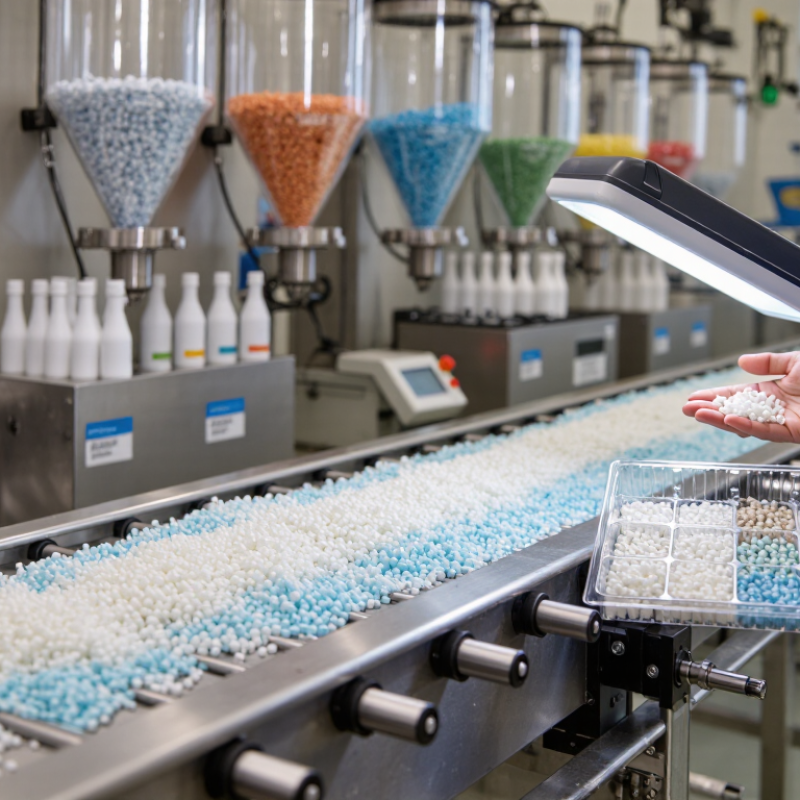
Plastic granules are small, standardized pieces of polymer resin used as manufacturing feedstock. They may be made from virgin polymers, recycled materials, or blends. Additives can improve color, flexibility, flame resistance, or ultraviolet stability. The granules usually flow into a heated barrel, where they melt before injection molding, extrusion, or blow molding. In practical terms, they resemble dry beads, not finished plastic products.
Their uniform shape supports accurate dosing and consistent processing. A factory can weigh thousands of granules, then convert them into pipes, containers, appliance parts, or films. According to Plastics Europe’s Plastics—The Fast Facts 2024, global plastics production reached about 414 million tonnes in 2023. That scale explains why granules remain central to modern manufacturing. Yet volume alone does not prove efficiency. Poor storage can introduce moisture, dust, or mixed materials, causing bubbles, weak surfaces, and rejected parts.
Recycled granules require closer attention. The OECD’s Global Plastics Outlook reported that only about 9% of plastic waste was ultimately recycled in 2019. This figure exposes a practical gap between recyclable design and reliable material recovery. Recycled pellets may vary in color, melt flow, and contamination levels. They need testing, not assumptions. A technician may check moisture content, melt-flow rate, and batch traceability before production. The process is highly controlled, but never perfectly predictable. That limitation deserves more honest reporting.
Plastic granules are produced by converting raw polymers into small, consistent pellets. Manufacturers begin by sorting the material according to polymer type, color, and intended use. Clean feedstock matters. Even a small amount of foreign material can weaken the final product.
The material is dried when moisture could affect processing. It then enters a heated extruder, where rotating screws melt and mix it under controlled temperature and pressure. Filters remove dust, metal fragments, and unmelted particles. The molten polymer leaves through a die as thin strands. These strands pass through a cooling bath before rotating knives cut them into granules. Some facilities use underwater pelletizing instead, especially when uniform pellet shape is important.
Quality control continues after cutting. Technicians check pellet size, moisture content, color consistency, and melt flow behavior. Samples may also undergo tensile or impact testing before release. Batch records help trace raw materials, processing conditions, and inspection results. This practical control supports reliable molding and extrusion.
The process is precise, but not flawless. Overheating can darken the polymer or reduce its strength. Uneven cooling may produce irregular pellets. In my view, manufacturers should not treat appearance as proof of quality. A clean-looking granule can still perform poorly if its moisture level or molecular structure is wrong. Small adjustments often make a measurable difference.
Manufacturers use plastic granules because they provide a controlled, practical feedstock for molding and extrusion. Each small pellet can be weighed, blended, heated, and shaped with repeatable settings. On a production floor, this consistency helps operators manage temperature, pressure, and cycle time. Granules also move efficiently through hoppers and automated feeding systems. Small details matter.
Different polymers and additives can be combined to produce parts with required flexibility, strength, color, or heat resistance. A technician may adjust the blend for a food container, pipe fitting, or protective housing. Moisture control is essential, since wet material can create bubbles, weak spots, or rough surfaces. Proper storage in sealed containers protects quality before processing. This is practical chemistry.
Granules also simplify inventory, quality testing, and material recovery. Suppliers can test melt flow, density, color, and contamination before production begins. Reprocessed granules may reduce waste, but their performance can vary after repeated heating. Manufacturers must check them carefully rather than assume every batch behaves identically. That extra testing costs time. Yet plastic granules are not a perfect solution. They depend on responsible sourcing, efficient processing, and thoughtful end-of-life planning. Industry expectations are still changing.
Plastic granules are used across many industries because they offer controlled properties, efficient processing, and consistent batch performance. Their small, uniform shape helps factories feed material into injection molding, extrusion, and blow molding equipment with fewer interruptions.
The packaging industry uses granules for bottles, food containers, films, caps, and protective trays. Different polymer grades provide flexibility, clarity, moisture resistance, or stiffness. Automotive manufacturers use them for dashboards, cable covers, door panels, clips, and lightweight structural parts. Engineers often select reinforced granules when heat resistance or impact strength matters.
Construction companies use plastic granules in pipes, insulation layers, window frames, flooring, and waterproof membranes. Electrical and electronics manufacturers need compounds that protect wires, connectors, and housings from heat or abrasion. Medical production also uses carefully specified granules for trays, tubing, laboratory containers, and selected device components.
Agriculture depends on granules for irrigation pipes, greenhouse films, seedling trays, and storage containers. Consumer goods factories mold them into toys, furniture parts, kitchen tools, and reusable household products. Textile producers may process certain granules into synthetic fibers and technical fabrics.
Material selection is not simple. Moisture, contamination, melt flow, color stability, and processing temperature can change the final product. In production audits, poor storage often causes bubbles, weak surfaces, or uneven color. That detail is easy to overlook. Recycling can reduce waste, but recycled granules may vary more between batches. Manufacturers should test each supply carefully instead of trusting appearance alone.
| Industry | Common Polymer Granules | Typical Manufacturing Processes | Typical Products | Why Granules Are Used | Important Material Properties |
|---|---|---|---|---|---|
| Packaging | Polyethylene (PE), polypropylene (PP), polyethylene terephthalate (PET) | Blow molding, injection molding, film extrusion, sheet extrusion | Bottles, containers, caps, films, trays, and flexible packaging | Granules melt consistently, flow through processing equipment, and support high-volume production. | Low weight, moisture resistance, sealability, chemical resistance, and impact strength |
| Automotive | PP, acrylonitrile butadiene styrene (ABS), polyamide (PA), polycarbonate (PC), thermoplastic elastomers (TPE) | Injection molding, extrusion, compounding, and overmolding | Interior panels, housings, trim parts, fluid reservoirs, clips, and seals | Granules allow precise formulation with fillers, fibers, pigments, and performance additives. | Low density, dimensional stability, heat resistance, toughness, and design flexibility |
| Electrical and Electronics | ABS, PC, polybutylene terephthalate (PBT), polyamide (PA), and flame-retardant engineering plastics | Injection molding, extrusion, and insert molding | Connector housings, cable conduits, switch components, appliance housings, and insulation parts | Uniform granules help maintain electrical, thermal, and mechanical performance from batch to batch. | Electrical insulation, flame resistance, heat stability, precision, and dimensional control |
| Construction | Polyvinyl chloride (PVC), PE, PP, and polyurethane (PU) | Profile extrusion, pipe extrusion, injection molding, and rotational molding | Pipes, fittings, window profiles, flooring components, insulation parts, and geomembranes | Granules provide a controlled feedstock for continuous profiles and large, durable molded parts. | Weather resistance, corrosion resistance, durability, low maintenance, and thermal insulation |
| Medical and Healthcare | PP, PE, PVC, thermoplastic polyurethane (TPU), and medical-grade elastomers | Injection molding, extrusion, blow molding, and film casting | Syringe components, tubing, diagnostic containers, fluid bags, and protective packaging | Granules support controlled processing, repeatable dimensions, and the use of specialized formulations. | Chemical resistance, clarity, flexibility, sterilization compatibility, and biocompatibility where required |
| Agriculture | PE, PP, PVC, and ethylene-vinyl acetate (EVA) | Film extrusion, pipe extrusion, injection molding, and rotational molding | Irrigation pipes, greenhouse films, mulch films, crates, tanks, and equipment components | Granules can be compounded with stabilizers, pigments, and additives for outdoor use. | Ultraviolet resistance, flexibility, moisture resistance, toughness, and low weight |
| Consumer Goods | PP, PE, ABS, PS, PC, and TPE | Injection molding, thermoforming, extrusion, and rotational molding | Household storage products, toys, furniture components, kitchenware, and sporting goods | Granules are easy to measure, blend, color, store, and feed into automated machinery. | Aesthetic versatility, impact resistance, affordability, light weight, and processability |
| Textiles and Fibers | PET, PP, PA, and elastomeric polymers | Melt spinning, fiber extrusion, film extrusion, and nonwoven production | Filaments, yarns, nonwoven fabrics, technical textiles, and industrial fibers | Granules can be melted and spun into continuous fibers with controlled thickness and strength. | Strength-to-weight efficiency, abrasion resistance, flexibility, and moisture management |
| Industrial Equipment | PA, POM, PBT, PC, PVC, and high-performance thermoplastics | Injection molding, extrusion, machining from semi-finished shapes, and compounding | Gears, bearings, guards, machine housings, rollers, valves, and conveyor components | Granules enable engineered formulations that are tailored to load, temperature, friction, and chemical conditions. | Wear resistance, low friction, stiffness, fatigue resistance, and chemical stability |
| Renewable Energy | PC, PA, PBT, PP, PVC, and thermoplastic elastomers | Injection molding, extrusion, overmolding, and cable-compound production | Cable protection, electrical enclosures, seals, brackets, conduit, and equipment housings | Granules provide repeatable processing and allow additives or reinforcement to be incorporated efficiently. | Weather resistance, electrical insulation, thermal stability, durability, and flame resistance where required |
Plastic granules are selected according to the product’s purpose, shape, and working conditions. A flexible seal may require soft thermoplastic material, while a rigid housing needs higher stiffness and impact resistance. Temperature exposure also matters. Granules used near heat sources must tolerate repeated heating without losing strength.
Processors inspect the resin grade, color, moisture level, and pellet size before production. Moisture can create bubbles, silver streaks, or weak surfaces during molding. Drying time depends on the material, pellet condition, and local humidity. It is not always safe to copy yesterday’s settings. Small changes can affect the final result.
During processing, granules enter a heated barrel and gradually melt. A screw mixes and pushes the melt into a mold or extrusion die. Operators monitor temperature, pressure, cooling time, and flow. A slightly uneven feed may cause visible defects. Sometimes, the chosen material seems suitable on paper but performs poorly in actual production. That gap deserves investigation, not excuses. Sample testing, dimensional checks, and impact tests help confirm whether the granules match the design. Scrap levels should also be reviewed, because quality includes efficiency and responsible material use.
Typical density of commonly selected thermoplastic granules
Plastic granules are used because they can be accurately metered, melted, mixed with additives, and formed into consistent products through processes such as injection molding, extrusion, and blow molding. Density is one practical selection factor: lower-density materials can reduce product weight, while higher-density materials may provide greater mass and stiffness. The values shown are representative midpoints of commonly published density ranges; the actual value varies by grade, additives, and processing conditions.